Table of Contents
ToggleSmall kitchens come with big challenges, and one of the most overlooked is lighting. Poor lighting makes a compact kitchen feel cramped, cuts down on safety, and turns meal prep into a chore. The solution isn’t a single bright bulb, it’s layered lighting that combines overhead fixtures, task lights, and accent lighting to create depth and functionality in tight quarters. This guide walks you through practical small kitchen lighting ideas that work within real constraints: limited ceiling space, awkward layouts, and modest budgets. Whether you’re renting or own, you’ll find solutions that brighten your workspace without requiring extensive electrical work.
Key Takeaways
- Small kitchen lighting ideas using layered lighting—combining overhead, task, and accent fixtures—eliminate shadows, improve safety, and make compact spaces feel larger.
- Task lighting with pendant fixtures over sinks and counters is essential for functionality, requiring 500–1,000 lumens to ensure safe food prep and cleaning.
- Under-cabinet LED strip lights are the highest-impact, most DIY-friendly upgrade, adding visibility and visual depth to small kitchens for $20–$50.
- Warm white (2700K) bulbs work best for overhead and accent lighting in compact kitchens to maintain an inviting feel, while 4000K (neutral white) suits task lighting for clarity.
- LED bulbs outperform CFL and incandescent options with 3x efficiency, 15–25 year lifespans, and affordable costs ($1–$3 per bulb), making them ideal for layered lighting setups.
- Track lighting offers flexible adjustability without rewiring, allowing you to redirect spotlights across your sink, counter, and island for about $80–$200 installed.
Why Layered Lighting Matters in Compact Kitchens
A single overhead fixture, the traditional “boob light” flush-mount, leaves shadows on counters and doesn’t help you see what you’re actually cooking. Layered lighting solves this by combining three types: ambient (general room light), task (focused light over work areas), and accent (mood or highlighting). In a small kitchen, this approach does double duty: it makes the space feel larger by eliminating harsh shadows, and it puts light exactly where you need it.
Consider how a compact kitchen functions. You’re working at the sink, chopping on a counter, maybe standing at a narrow island. Each zone needs its own light source. Without this strategy, you end up leaning over your cutting board, squinting at recipes on your phone, or reaching for the overhead switch five times during dinner prep. Layered lighting also reduces glare and eye strain, critical when you’re working in a tight space where fixtures hang lower than in larger kitchens.
Beyond function, proper lighting opens up the space visually. Shadows make rooms feel smaller: well-placed light makes them feel bigger. This is why professional designers always start with a lighting plan, not an afterthought. For small kitchens especially, treating lighting as a primary design element, not a convenience, pays off immediately.
Overhead Lighting Solutions for Small Kitchens
Flush Mounts and Semi-Flush Fixtures
Flush-mount fixtures sit tight against the ceiling, making them ideal for kitchens with standard 8-foot ceilings or drop ceilings. They don’t hang down and block sightlines or bump your head. A semi-flush fixture, one that extends 4 to 8 inches, offers a middle ground, giving a bit of design presence without excessive drop. Look for models with white or brushed nickel finishes and diffuser panels that spread light evenly.
For a small kitchen, aim for a fixture in the 12- to 16-inch diameter range. Anything larger visually dominates a compact ceiling. Choose models with multiple bulbs (three or four) so you get adequate brightness: small kitchens often need 40 to 50 lumens per square foot from overhead light alone. LED bulbs in these fixtures will run 60–90 watts total, cutting energy use versus older incandescent or CFL setups.
Installation is straightforward: turn off power at the breaker, remove the old fixture, and wire in the new one using a standard ceiling box. If your existing box is cracked or loose, reinforce it. This is a solid weekend DIY task, no permit needed in most jurisdictions, though if you’re uncomfortable with electrical work, a licensed electrician takes an hour and costs $150–$250.
Track Lighting for Flexibility
Track lighting is a game-changer for small kitchens because you adjust where light falls without rewiring. A single 12- to 24-inch track mounted perpendicular to your cabinets lets you aim spotlights exactly where you prep food or clean up. Tracks come in low-voltage (12V) and standard-voltage (120V) versions: standard voltage is simpler to install and more widely available.
Each track head typically takes a 25–40-watt equivalent LED bulb and pivots 360 degrees. This flexibility means one track can light your sink, your counter, and your island as needed. Many homeowners pair a track system with a dimmer switch, so you can dial down light for evening cooking and ramp it up for detailed tasks.
Track systems mount to your ceiling or under a soffit using a simple bracket and bolts. If wiring already exists in that location, you can splice into it, a job for a confident DIYer or an electrician. Cost runs $80–$200 for a basic 3- to 4-light track plus fixtures, versus $500+ for hiring out. The payoff is flexibility that a fixed flush mount can’t deliver.
Task Lighting to Brighten Your Workspace
Task lighting sits directly over your work surface, whether that’s a sink, counter, or island. This is where small kitchen lighting makes the biggest functional difference. A dimly lit sink turns simple cleanup into a frustrating guessing game: proper task light makes you safer and faster.
Pendant lights are the natural choice here. A single pendant over a sink or a pair flanking an island provides focused, flattering light without eating much ceiling height. Look for pendants 8 to 12 inches in diameter, large enough to deliver light but not so large they overwhelm a compact space. Frosted or diffused glass softens shadows: clear glass or open industrial designs add style but can feel harsh if your light source is too bare. A pendant on a 4- to 6-inch drop chain is typical and works well in most kitchens.
When shopping for task pendants, check the lumens output. A single pendant over a sink should deliver 500 to 1,000 lumens (roughly 40–75 watts equivalent LED). Test how it distributes light: some designs throw light in a concentrated beam, while others spread it wider. The wider spread is usually better for counters where you’re moving around. Pendant lighting options range from budget glass and brass to designer pieces, but the core principle remains: focused light, appropriate lumens, and a mount that doesn’t crowd your ceiling.
Installation requires a ceiling outlet and a simple junction box (if one doesn’t exist, you’ll need an electrician to run wiring). Hanging the pendant is DIY-friendly: twist the shade on or off, plug in a dimmable LED bulb, and adjust the chain length to your preference. Most pendants hang 30 to 36 inches above a counter, though that varies by fixture size and personal preference, test the height before you finalize the installation.
Under-Cabinet and Accent Lighting Tricks
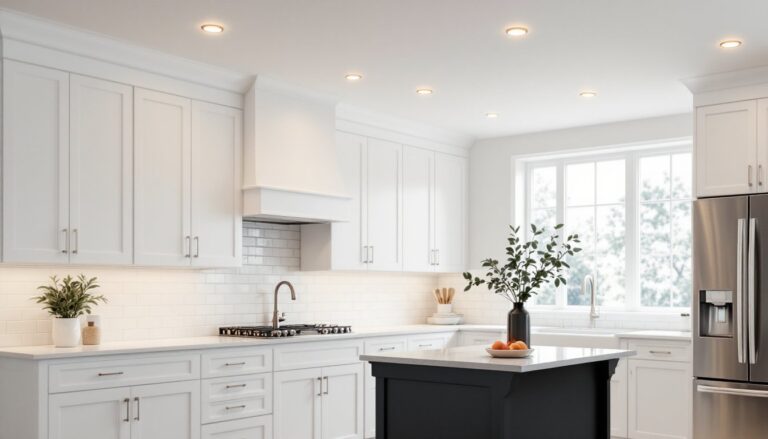
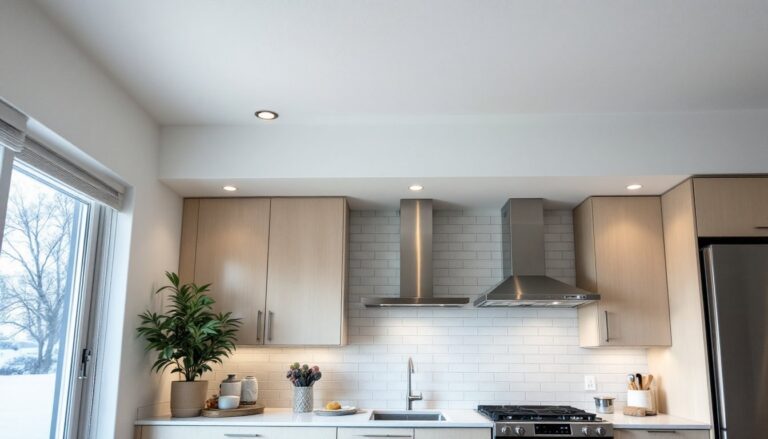
Under-cabinet lighting is one of the highest-impact upgrades in a small kitchen, and it’s one of the most accessible DIY projects. It adds visibility for countertop work, reduces the cave-like shadow zone under overhanging cabinets, and creates a subtle ambient glow that makes the space feel larger.
LED strip lights are the workhorse here. They’re thin, bright, and available in different color temperatures (warm to cool white). Self-adhesive versions peel and stick to the underside of your wall cabinets in minutes, no wiring, no mounting brackets, no fuss. Plug-in strips cost $20–$50 and deliver 400–600 lumens across a 24- to 36-inch run. Hardwired strips (requiring a licensed electrician to splice into your kitchen circuit) cost more but look cleaner and let you integrate them into a dimmer control.
Place the strip light as far back under the cabinet as possible so the light shines onto your counter, not your eyes. If the strip is visible from above the cabinet, install a thin aluminum diffuser channel ($10–$20) to hide it. This one detail separates a polished kitchen from one that looks DIY-patched.
Under-cabinet lighting options are worth exploring in depth because the market has exploded: smart LEDs that sync to your phone, color-changing strips, motion-sensor versions. For most small kitchens, though, a simple warm-white LED strip with an on/off switch does the job beautifully and costs less than takeout.
Accent lighting, decorative light that highlights open shelving, a backsplash, or a feature wall, is optional but effective in small spaces. Thin LED strips in warm white (2700K) along a glass shelf or above open cabinetry add visual interest and layering. It’s the same technology as under-cabinet light, just positioned for aesthetics rather than function. Reserve accent lighting for after you’ve nailed down ambient and task light.
Choosing the Right Color Temperature and Bulbs
Color temperature, measured in Kelvins (K), affects how your kitchen feels and functions. 2700K (warm white) is cozy and familiar, mimicking incandescent light. 4000K (neutral white) is crisp and energetic, often preferred in work-focused spaces. 5000K (cool white) is bright and clinical, better for detailed tasks but can feel harsh in a small, intimate space.
For small kitchens, a mixed approach works best: use 2700K in ambient overhead light (it makes the space feel inviting and less cramped), 4000K in task lighting over sinks and counters (it provides clarity for food prep), and 2700K in accent or under-cabinet light (it ties the layers together and maintains warmth). Avoid cool white as your primary light, it ages kitchens and can make small spaces feel cold.
Choose LED bulbs over CFL or incandescent. LEDs are three times more efficient, last 15 to 25 years, produce minimal heat, and now cost only $1–$3 per bulb in bulk. Check the lumen output on the package (it’s labeled clearly) rather than wattage, lumens tell you actual brightness. A 60-watt equivalent LED is roughly 800 lumens: a 40-watt equivalent is about 450 lumens. Small kitchens benefit from dimmable LEDs paired with a dimmer switch, letting you adjust mood from meal prep to evening ambiance.
One critical note: verify your fixture is rated for the wattage and bulb type before you buy. Some older brass fixtures or certain track systems have limits. If unsure, ask at a lighting supply store (like a local Lowe’s or independent shop) or check the fixture paperwork. Mismatched bulbs and fixtures can overheat and fail early, wasting money and time.
When shopping, look for bulbs certified by Energy Star and labeled with color temperature and lumens. Ignore vague claims like “daylight” or “bright”, real data on the package is what matters. Quality matters here: mid-range LEDs ($2–$4 each) outlast rock-bottom models by years.