Table of Contents
ToggleGood bathroom lighting isn’t an afterthought, it’s the difference between a space that looks flat and exhausted versus one that feels inviting and functional. Whether you’re standing at the mirror for a shave or a makeup routine, soaking in the tub, or just getting ready in the morning, the right fixtures make all the difference. In 2026, bathroom lighting has moved beyond the standard builder-grade fixtures, offering homeowners countless options to layer light, control glare, and add personality. This guide walks you through seven practical bathroom lighting solutions that combine style with real-world performance, so you can make informed choices for your next renovation or refresh.
Key Takeaways
- Bathroom lighting fixtures should layer task, ambient, and accent light to create both functional and beautiful spaces that combine style with real-world performance.
- Vanity fixtures mounted 12–18 inches above the mirror and 24–48 inches wide deliver 50–100 foot-candles of light, with frosted or diffused shades reducing harsh shadows and glare.
- LED bulbs and dimmable fixtures are essential choices, offering 25,000+ hours of lifespan, cooler operation, and flexibility to adjust brightness throughout the day for different moods.
- Color temperature matters: use warm 3000K lighting for relaxing areas like soaking tubs, and neutral 3500–4000K at the vanity for clarity during grooming tasks.
- Recessed lighting fixtures provide modern appeal for accent or general illumination, with 4–6 inch sizes working best for bathrooms while maintaining 12 inches of clearance from insulation.
- Wall sconces positioned 36–40 inches from the floor and 24 inches apart eliminate shadows and create professional, flattering lighting—pairing them with dimmers maximizes functionality and ambiance.
Vanity Lights for Functional Elegance
The vanity, where your mirror and sink live, is ground zero for bathroom lighting. You need enough light to see what you’re doing, but not so much that you squint or see harsh shadows under your eyes and chin. A quality vanity fixture typically mounts horizontally above the mirror or on both sides, and it should deliver between 50 and 100 foot-candles of light directly at face level.
Horizontal bars mounted above the mirror are classic and effective. Look for fixtures that are at least 24 inches wide for a standard single vanity: wider mirrors and double vanities benefit from 36- to 48-inch fixtures. The fixture should sit about 12 to 18 inches above the mirror’s top edge. Sconces flanking the mirror are another strong option, they reduce shadows and create a more balanced, flattering light. For maximum functionality, choose fixtures with frosted or diffused shades rather than clear ones: they soften the light and reduce glare.
When selecting fixtures, prioritize ones with LED or dimmable halogen bulbs. LEDs run cooler, last longer (25,000+ hours), and won’t heat up your bathroom on a hot day. Dimmers give you flexibility: bright and energizing in the morning, softer in the evening. Above all, test your fixture before installation, bring photos of your bathroom to the showroom if possible, and consider how the light color will interact with your tile and cabinetry. Modern vanity fixtures range from minimalist chrome bars to ornate vintage-inspired designs, so you’ll find something that matches your bathroom’s personality.
Ceiling Lights and Overhead Options
Most bathrooms need at least one ceiling fixture to provide general, ambient light. This might be a simple flush-mount, a semi-flush that hangs a few inches below the ceiling, or a modest chandelier if your bathroom has higher ceilings. The key is distributing light evenly across the entire space without creating dark corners or excessive brightness directly over your head.
For a typical 5×8 bathroom, a 60- to 75-watt equivalent LED fixture (or about 800–1000 lumens) works well as your main overhead light. If your bathroom is smaller, dial back to 40–60 watts. Larger bathrooms (10×12 or bigger) may need two smaller fixtures or one larger one. Placement matters: the fixture should sit roughly centered in the room, though you can offset it slightly if your layout demands it.
Flush-mount fixtures sit flush against the ceiling and work in rooms with lower ceilings (under 8 feet). Semi-flush fixtures hang 4–12 inches and suit standard ceiling heights. Both styles come in countless finishes, brushed nickel, matte black, brass, and more, making it easy to coordinate with your vanity lights and other hardware. Avoid fixtures with exposed bright bulbs pointing downward: they’ll create uncomfortable glare. Instead, choose designs with frosted glass or diffusers. If your bathroom has a skylight or window, your overhead fixture can be dimmer since natural light supplements it. Consider pairing your ceiling light with a separate dimmer switch to adjust brightness throughout the day and create mood.
Accent and Ambient Lighting Ideas
Recessed Lighting for Modern Appeal
Recessed lights, those small, flush fixtures embedded in your ceiling, deliver a clean, uncluttered look and are hugely popular in modern bathrooms. They’re especially useful for highlighting specific zones: above the tub, along the shower surround, or framing a feature wall. Recessed fixtures are available in 3-inch, 4-inch, and 6-inch diameters: smaller sizes work for accent lighting, while 4-inch and 6-inch are standard for general illumination.
When installing recessed lights, maintain at least 12 inches of clearance from insulation and HVAC ducts. In older homes without attic space above, you might need shallow “remodel” cans rather than new-construction housings. Always use IC-rated (insulation contact) cans if they’ll sit in insulated spaces: non-IC cans can overheat. Recessed lights generate heat, so ventilation matters, especially in a humid bathroom environment. Consider installing a vent fan in the same circuit or on a separate timer to manage moisture.
Recessed lights come with different trim options, baffle (matte finish, reduces glare), reflector (brightens output), or eyeball (adjustable). For a bathroom, baffled or reflector trims are more flattering than bright eyeball trims. LED retrofit kits allow you to upgrade existing recessed fixtures without replacing the housing, saving money on renovations.
Wall Sconces and Specialty Fixtures
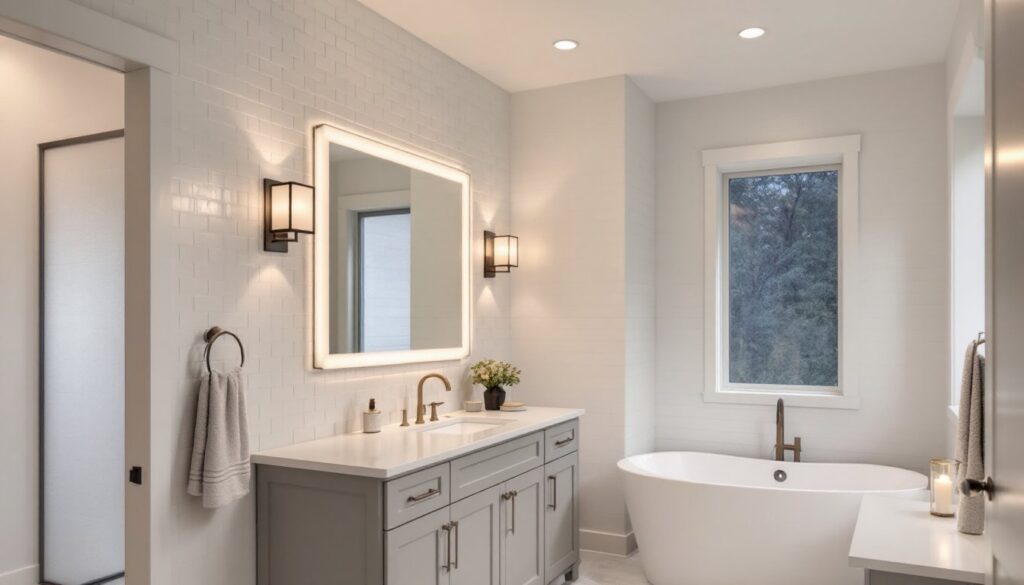
Wall sconces mounted on either side of the mirror or elsewhere in your bathroom add depth and eliminate shadows. A pair of identical sconces flanking a mirror is a tried-and-true approach: position them 36 to 40 inches from the floor and roughly 24 inches apart (for a standard vanity). This configuration mimics professional dressing-room lighting and delivers flattering, shadow-free illumination at face level.
Sconces aren’t limited to the vanity area. In larger bathrooms, a sconce on a blank wall or near a soaking tub creates ambient lighting and adds visual interest. They’re also ideal for reading in the tub without the overhead feeling too bright. Look for models with dimmable, warm-white LEDs (2700K color temperature) for relaxing spaces like the bathtub.
Other specialty fixtures worth considering include pendant lighting: transform your, which works well in larger bathrooms with higher ceilings, and linear suspensions over a double vanity, these hang horizontally and distribute light evenly across both sink areas. Vintage-inspired glass or ceramic shades add personality without sacrificing function.
Choosing the Right Brightness and Color Temperature
Lumens and color temperature sound technical, but they’re crucial to getting lighting that feels right in your bathroom. Lumens measure brightness: color temperature (measured in Kelvin, or K) describes whether light feels warm (yellowish) or cool (bluish).
For bathrooms, the industry standard recommends 3000K to 4000K color temperature. 3000K feels warm and spa-like, great for creating a relaxing atmosphere in the evening or near a soaking tub. 4000K is neutral and slightly cool, ideal for task lighting where you need to see detail, your vanity mirror, for instance. Some homeowners use a blend: warm 3000K ambient light from the ceiling or wall sconces, paired with slightly cooler 3500K or 4000K at the vanity for better clarity.
Brightness needs vary by function. Your vanity mirror needs 50–100 foot-candles (roughly 500–1000 lumens across the fixture). General ambient lighting, ceiling fixtures, sconces, should provide 30–50 foot-candles. A soaking tub benefits from softer, dimmer lighting, 10–20 foot-candles, to encourage relaxation. Recessed lighting: transform your allows you to zone these brightness levels, putting brighter task lights where you need them and softer accent lights elsewhere.
When shopping for bulbs, always check the packaging for lumens and color temperature, not just wattage. An LED bulb labeled “60W equivalent” might deliver 800 lumens, while another claims 900. The packaging clearly states both. Dimmable LEDs often cost a bit more upfront but give you the flexibility to adjust mood and save energy. Test samples if possible, some LED “warm white” bulbs feel slightly different across brands. In terms of research, design resources like Hunker and Homify showcase real bathrooms where you can see how different lighting approaches look in practice.
Conclusion
Bathroom lighting is about layering, combining task, ambient, and accent light to create a space that’s both functional and beautiful. Start with a solid vanity fixture and overhead light, then add depth with wall sconces or recessed lighting if your budget and layout allow. Pay attention to color temperature and brightness levels, and don’t underestimate the power of dimmers to transform mood throughout the day. With the right fixtures in place, your bathroom becomes more than a utility room, it becomes a refuge.