Table of Contents
ToggleLED lighting has quietly transformed how homeowners approach kitchen illumination over the past decade. What once meant choosing between harsh overhead fluorescents or warm incandescents now offers a spectrum of options, literally and figuratively. Modern LED fixtures deliver precise brightness, adjustable color temperatures, and energy efficiency that older technologies simply can’t match. Whether you’re refreshing a decade-old kitchen or building from scratch, understanding LED solutions helps you avoid expensive mistakes and create a space that actually functions well when you’re cooking at 7 p.m. on a weeknight. This guide walks you through types, layout strategy, installation fundamentals, and the technical specs that matter for real-world kitchen work.
Key Takeaways
- LED lighting for the kitchen cuts electricity costs by 80–90% compared to incandescents, saving $160–$200 annually on typical kitchen fixtures while lasting 15–20 years instead of 1 year.
- Layer your kitchen lighting with overhead ambient (40%), task (40%), and accent (20%) fixtures to eliminate dark corners and glare while maintaining flexibility for different times of day.
- Under-cabinet LED strips at 2,700–3,000K color temperature are essential for countertop work, while warm white ambient lighting prevents the clinical feel of older fluorescents.
- New fixture installation requires turning off power at the breaker, using a voltage tester for safety, and confirming dimmer compatibility—upgrade to LED-compatible dimmers ($15–$40) if your current dimmer flickers.
- LED kitchen lighting performs best when mounted in well-ventilated fixtures positioned 18–24 inches away from heat sources like ranges, and annual dusting maintains brightness and lifespan.
Why LED Lighting Is The Smart Choice For Your Kitchen
LED technology dominates modern kitchens for reasons that go beyond buzzwords. Unlike incandescent bulbs that waste 90% of their energy as heat, LEDs convert roughly 80% of input energy into usable light. In a kitchen, where fixtures run five to eight hours daily, this difference stacks up fast.
Energy Efficiency & Cost Savings
A typical incandescent 60W bulb costs about $0.07 per day to run (at $0.12/kWh). An equivalent LED at 9W costs roughly $0.01 per day. Over a year, that’s $20+ saved per bulb. A kitchen with eight active fixtures saves $160–$200 annually in electricity alone. LEDs last 25,000–50,000 hours versus 1,000 hours for incandescent, so you’re replacing bulbs every 15–20 years instead of annually. Labor and annoyance factor in too: fewer trips to swap burned-out bulbs above the range hood is a real win. The upfront cost, typically $8–$25 per bulb, pays for itself in two to three years, especially in high-use spaces like kitchens.
Types Of LED Kitchen Lighting Solutions
Kitchen lighting isn’t one fixture doing everything: it’s layers working together. Understanding the main categories helps you plan a layout that actually works.
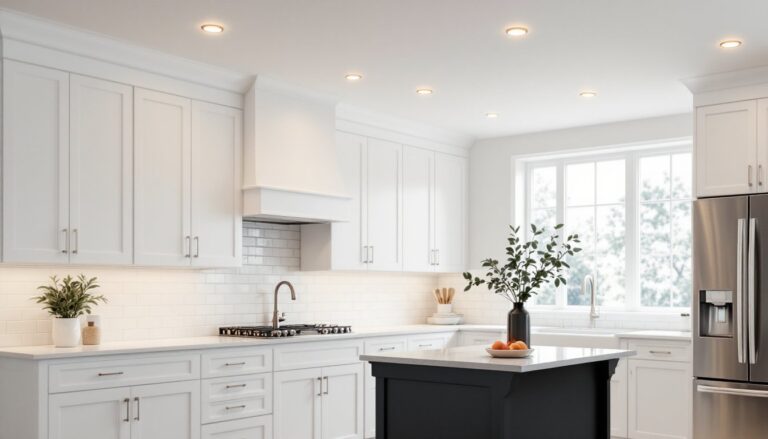
Overhead / Ambient Lighting provides general illumination. Flush-mount or semi-flush fixtures (6–12 inches from ceiling) suit smaller kitchens: pendant clusters or chandeliers work in larger spaces. Recessed downlights are popular for modern aesthetics, though they require new construction or retrofit housing. Recessed lighting housing guides detail installation, but know upfront: cutting ceiling holes and running wiring usually demands basic electrical confidence.
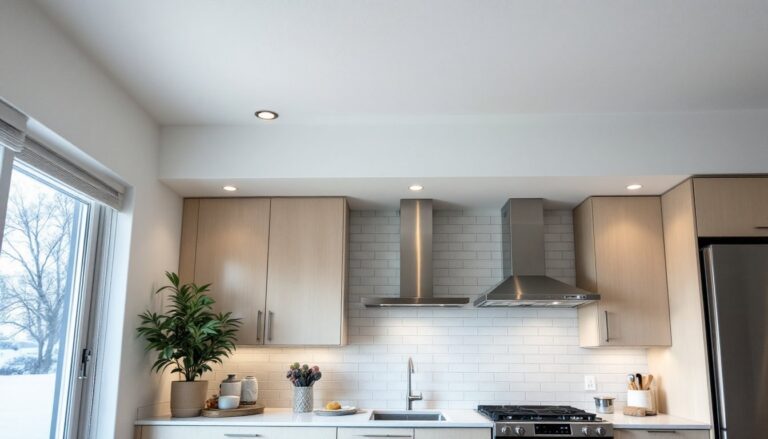
Task Lighting focuses on work surfaces. Under-cabinet LED strips are workhorses for countertops and prep areas. They’re shallow, run on low voltage (12V or 24V), and direct light downward without glare. Pendant lights centered over islands provide both task and accent impact. Pendant lighting fixtures hang 30–36 inches above counters: measure twice so heads don’t bonk fixtures mid-meal.
Accent / Decorative Lighting highlights features. LED strips inside glass cabinet doors, above crown molding, or behind shelving add depth and visual interest. Above-sink lighting often pulls double duty as task and accent work.
Linear and Strip LEDs are increasingly affordable. These come in dimmable and non-dimmable versions: always confirm compatibility with your dimmer switch before buying. Dimmable LEDs cost more but offer flexibility.
Designing The Perfect Kitchen Lighting Layout
A solid layout prevents dark corners and glare. Start by mapping your kitchen zones: prep areas (counters, sink), cooking (range/cooktop), dining (table or island), and cleanup.
Ambient lighting should reach all zones without harsh shadows. A 400–600 lumens fixture suits a 100–150 sq ft kitchen: scale up for larger spaces. One or two centrally positioned ceiling fixtures often underperform: consider multiple smaller fixtures or a combination strategy.
Task lighting must directly illuminate work surfaces. Under-cabinet strips are non-negotiable for countertops: aim for 2,700–3,000K color temperature (warm white) here for a natural look. Islands or standalone counters benefit from two pendant lights spaced 24–30 inches apart, close enough for even coverage, far enough apart to avoid a single hot spot.
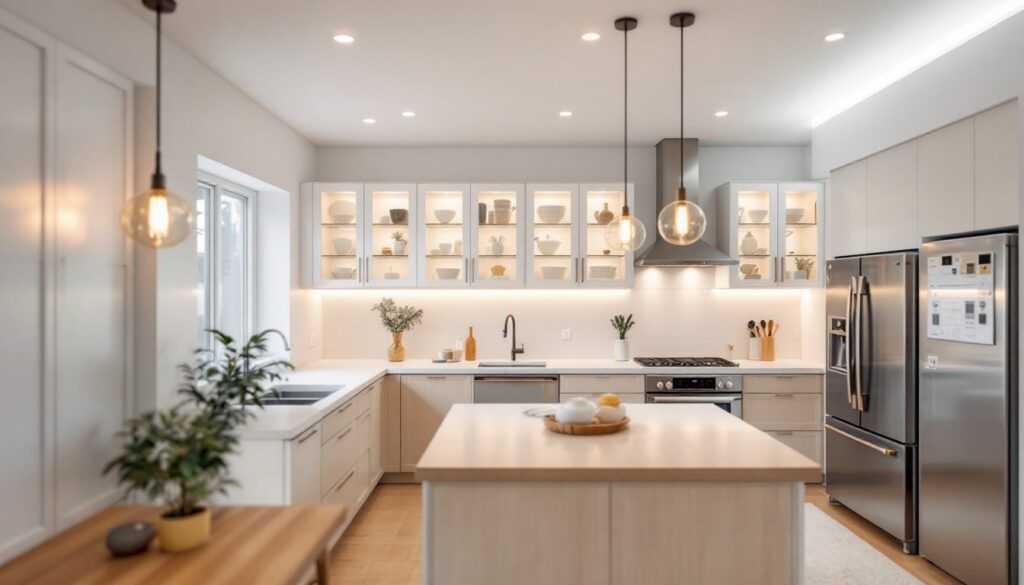
Layer your light: combine overhead (40%), task (40%), and accent (20%) for balanced, flexible illumination. This way, you can dim overhead fixtures for evening and rely on task lighting during active cooking.
Before purchasing, measure ceiling heights and distances. Sketch rough placements. Odd spacing creates visual confusion: even intervals feel intentional. If modifying ceiling fixtures, confirm whether your ceiling is drywall, plaster, or structural (load-bearing beams need different mounting approaches).
Installation Tips For DIY Enthusiasts
Most LED replacements are straightforward swaps, but new fixture installation requires more care.
Replacing existing bulbs is the easiest entry point. Note the bulb base type (E26 standard US screw, GU10 pin-based, or G9 pin-contact) and wattage equivalent. Swap old for new, and you’re done. Wear nitrile gloves to avoid fingerprints on LED bulbs (oils degrade lifespan).
Installing plug-in LED strips (adhesive-backed) is nearly as simple. Clean the mounting surface thoroughly with rubbing alcohol, dust and oils prevent adhesion. Press firmly for 30 seconds. Conceal wiring with wire channels or behind cabinet trim.
Adding new fixtures (pendants, flush-mounts, under-cabinet tracks) requires turning off power at the breaker and confirming no voltage remains using a non-contact voltage tester. Always wear safety glasses. If the existing outlet is in a finished ceiling or wall, you’ll likely need a drywall saw, which demands patience and a second pair of hands to hold materials steady. Running new wire in walls typically requires a licensed electrician in most jurisdictions (check local electrical codes).
Dimmer compatibility is critical: not all LEDs play nicely with older dimmers. Look for “dimmer-compatible” labels or check the bulb spec sheet. Standard incandescent dimmers often flicker with non-compatible LEDs. If your dimmer is original to an older home, upgrading to a modern LED-compatible dimmer (usually $15–$40) saves headaches.
Ventilation tip: When installing over or near a range, confirm fixtures are rated for heat exposure. Standard LEDs shouldn’t go directly above the burners: 18–24 inches horizontally is safer.
Choosing The Right Color Temperature & Brightness
Color temperature and brightness aren’t afterthoughts: they define how the space feels and performs.
Color Temperature is measured in Kelvin (K). Kitchen standards are:
- 2,700K (Warm White): Golden, relaxing tone. Best for ambient, dining, and evening use. Avoids the clinical feel of older fluorescents.
- 3,000K (Neutral White): Balanced, natural look. Works for task lighting and general kitchen work.
- 4,000K (Cool White): Bright, slightly blue-ish. Good for detailed prep work and professional kitchens, but can feel sterile for evenings.
- 5,000K+ (Daylight): Clinical, best for inspections or specific tasks, not primary kitchen lighting.
Mix temperatures strategically: 2,700K overhead and ambient, 3,000K task lighting. This avoids an all-white, sterile appearance while keeping work surfaces clearly visible.
Brightness is measured in lumens (not watts). A 60W incandescent outputs ~800 lumens: an LED equivalent delivers the same at ~9W. For kitchens:
- Per-fixture rule: 400–600 lumens per overhead fixture (depending on room size).
- Under-cabinet strips: 300–500 lumens total per side of the kitchen (spread across strips).
- Pendants over islands: 500–800 lumens each, positioned to spread light.
Brightness preference is personal, but most prefer slightly brighter task areas (3,500–4,000 lumens total for a typical kitchen) and softer ambient (1,500–2,000 lumens when dining). Dimmable fixtures let you adjust based on the time of day and activity.
Maintenance & Longevity
LED longevity depends on proper installation and environment. While rated for 25,000–50,000 hours, several factors can shorten lifespan.
Heat exposure is the primary killer. LEDs have a small heat sink (usually a finned base): if mounted in an enclosed, unventilated fixture or directly above a heat source, they cook themselves. Always ensure fixtures allow airflow and aren’t rated for temperatures above 50°C (122°F). Kitchens with high-humidity ranges should use fixtures rated for damp or wet locations.
Electrical stability matters. Power surges, unstable voltage, or poor dimmer compatibility degrade internal components over time. Install a whole-home surge protector if you’re in an area with frequent storms: it’s cheap insurance.
Cleaning is minimal but worthwhile. Dust on LED strips or fixtures reduces brightness and accelerates heat buildup. Wipe down annually with a soft, dry cloth. Avoid harsh chemicals that can damage finishes.
Warranty and support: Most quality LED bulbs carry 3–5 year warranties. Keep receipts and register products if the manufacturer offers it. Budget brands sometimes fail before rated hours, so choosing reputable manufacturers (even if pricier) pays off. Resources like The Kitchn and Digital Trends regularly test and rate kitchen lighting products, offering current buying guidance.
Replacing individual bulbs in a mixed fleet is awkward: plan for cohesion by replacing entire fixtures or bulb sets together. LEDs from different manufacturers can vary slightly in color, creating unintended warm or cool patches.