Table of Contents
ToggleBathroom lighting often gets treated as an afterthought, a simple overhead fixture that works, right? Wrong. Contemporary bathroom lighting is about more than just visibility: it’s about creating a space that feels intentional, functions properly, and reflects your personal style. Modern bathroom design demands a thoughtful approach to illumination, one that balances aesthetics with practicality. Whether you’re tackling a full renovation or upgrading fixtures, understanding the fundamentals of contemporary lighting will transform your bathroom from functional to genuinely enjoyable. Let’s dig into what separates outdated approaches from designs that work in 2026.
Key Takeaways
- Contemporary bathroom lighting requires intentional layering with three distinct levels—ambient, task, and accent—working together to balance functionality with aesthetics.
- Vanity lighting must flank the mirror at 36 to 40 inches apart and 60 to 66 inches high to eliminate unflattering shadows and ensure proper grooming visibility.
- Modern bathroom fixtures prioritize clean lines and material honesty in finishes like matte black, brushed brass, and frosted glass while avoiding outdated glossy or ornate designs.
- Color temperature selection is critical: use 3000K for ambient and accent lighting and 3500K to 4000K for task lighting to prevent institutional-feeling harsh light.
- Smart lighting solutions like dimmers and motion sensors offer practical convenience without complexity, allowing you to adapt contemporary bathroom lighting to different times of day.
- Fixture placement and IP ratings are essential: position recessed ceiling lights 4 to 6 feet apart and ensure fixtures within 3 feet of wet zones meet IP54 or higher standards.
Understanding Contemporary Bathroom Lighting Design
Core Principles of Modern Bathroom Aesthetics
Contemporary bathroom lighting starts with clarity about what contemporary actually means. It’s not all chrome and glass: it’s about clean lines, minimal clutter, and fixtures that serve multiple purposes. A modern bathroom prioritizes function without sacrificing visual appeal.
The first principle is intentional layering. Gone are the days when a single ceiling fixture sufficed. Today’s bathrooms demand multiple light sources working together. This approach prevents harsh shadows on the face (crucial for shaving and makeup), reduces eye strain, and creates flexible moods for different times of day.
The second principle is material honesty. Contemporary fixtures embrace natural materials, brushed brass, matte black, wood accents, and frosted glass. These materials age gracefully and complement the minimalist aesthetic without feeling sterile. Avoid overly glossy finishes: they read as dated and show fingerprints constantly.
The third principle is integration with daily rhythms. Bathrooms need bright, energizing light in the morning and softer, more forgiving illumination at night. This doesn’t mean buying separate fixtures for each mood, it means selecting dimmers and layered sources that adapt. Your lighting should support how you actually use the space, not force you to adapt to it.
Layering Light: The Three Essential Levels
Ambient, Task, and Accent Lighting Explained
Layered lighting is the foundation of any functional contemporary bathroom. Think of it as three distinct jobs working together:
Ambient lighting is your baseline, the overall illumination that lets you navigate the space safely. This traditionally came from a ceiling fixture, but contemporary design spreads this duty across the room. Recessed ceiling lights (typically 4-inch or 6-inch trims) positioned at intervals create even, shadow-free general illumination. A flush-mount fixture with an opal diffuser works too, but many designers favor recessed options for their cleaner aesthetic. Aim for at least 2.5 to 5 foot-candles of ambient light according to the International Code Council (ICC).
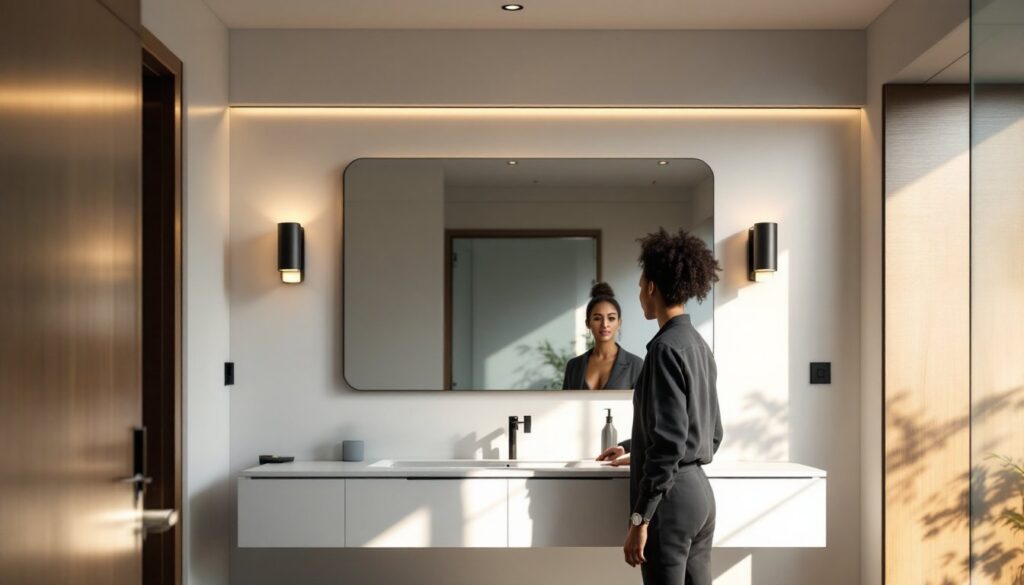
Task lighting focuses on the spaces where you actually work: the mirror and vanity. This is non-negotiable. Poor vanity lighting leads to over-applying makeup, missed whisker spots, and poor grooming overall. Wall-mounted sconces flanking the mirror or a pendant lighting option above the sink are contemporary standards. Position these at eye level when standing, usually 60 to 66 inches from the floor. Avoid light coming from directly above: it creates shadows under the eyes and chin. The best setup uses fixtures on both sides of the mirror, spaced 24 to 30 inches apart, to eliminate unflattering shadows.
Accent lighting highlights architectural features, adds visual interest, and creates ambiance. This might be recessed lighting behind a floating vanity, under-cabinet strips, or a statement fixture in a niche. Accent lights are typically dimmer and warmer (2700K color temperature) than task lighting. They shouldn’t be the primary light source but rather a finishing touch that brings the space together.
The magic happens when these three layers work together. During morning routines, you’d maximize task and ambient lighting. At night, dimming ambient light and using accent lighting creates a spa-like retreat. Control these independently with separate switches or smart controls for maximum flexibility.
Fixture Styles That Define Contemporary Bathrooms
Contemporary bathroom fixtures share a visual vocabulary: understated elegance, clean geometry, and purposeful design. Here’s what actually works in modern bathrooms.
Wall sconces are the workhorse. Cylinder sconces (often 4 to 6 inches in diameter) in matte black, brushed nickel, or brass dominate contemporary design. The best ones use integrated LED or A19 bulbs rated 2700K to 3000K, warm enough to feel inviting, cool enough to support grooming tasks. Avoid ornate, crystal-laden fixtures: they clash with minimalist aesthetics. Instead, look for clean-lined designs with diffusers that soften the light.
Ceiling fixtures have evolved. A slim, low-profile flush mount (typically 6 to 10 inches in diameter) in brushed metal or white enamel fits contemporary spaces better than traditional domes. Alternatively, recessed downlights with adjustable trims offer invisible ambient light without visual clutter. When you do use a ceiling fixture, keep it simple, no dangling crystals, ornate crowns, or excessive ornamentation.
Mirror-mounted fixtures are gaining ground. These attach directly to the mirror frame and eliminate the need for separate wall fixtures. They’re practical for small bathrooms where wall space is tight. Choose fixtures with adequate CRI (Color Rendering Index) of 90+ so you see true skin tones, non-negotiable for bathrooms.
Vanity bars above the sink (typically 20 to 30 inches wide) bridge the gap between wall sconces and mirror-mounted options. Contemporary bars feature minimalist designs: no visible bulbs, smooth diffusers, and finishes matching your hardware.
Color temperature matters more than most homeowners realize. Contemporary bathrooms typically use 3000K (warm white) for ambient and accent lighting and 3500K to 4000K for task lighting. This prevents the space from feeling cold or institutional. Always check the bulb specifications, many cheap fixtures default to harsh 5000K+ temperatures that feel like hospital lighting.
Remember that lighting secrets extend far beyond bathrooms, but bathroom-specific requirements demand more precision in placement and color rendering than almost any other room in your home.
Smart Lighting Solutions for Bathroom Functionality
Contemporary bathrooms increasingly integrate smart technology, and for good reason. Dimmers and smart bulbs solve real problems without adding complexity.
Dimmer switches are the simplest upgrade. A quality 3-way dimmer rated for LED (not all dimmers work with all LED bulbs, check compatibility) lets you adjust ambient and task lighting to your needs. Morning? Full brightness. Evening? Dial it down to 30 percent and add accent lighting for a relaxing atmosphere. Avoid cheap dimmers: they cause LED bulbs to flicker or hum, which is both annoying and a sign of poor fixture quality.
Smart bulbs and systems like Philips Hue, Nanoleaf, or Lutron offer color temperature adjustment and scheduling. You can program cooler light (4000K) for morning routines and warmer light (2700K) for nighttime. For bathrooms specifically, this solves the problem of harsh morning light without needing separate fixtures. Motion-sensor features also work well in bathrooms, lights turn on automatically when you enter, which is genuinely convenient, especially at 2 a.m.
Ventilation fan integration is practical but often overlooked. Some contemporary exhaust fans include integrated LED lighting (typically 4000K) and humidity sensors. This solves the problem of bathroom moisture while providing secondary ambient light. If installing new ventilation, consider a unit with integrated lighting: it reduces the number of ceiling penetrations and simplifies electrical work.
Smart mirrors with built-in LED rings around the perimeter are increasingly common in contemporary designs. These eliminate the need for separate vanity lighting and provide above-sink lighting that’s clean and integrated. They run $150 to $800 depending on features like demisting, magnification, and connectivity. For DIYers, these are easier than installing separate sconces if your mirror hasn’t been installed yet.
When choosing smart solutions, prioritize reliability and compatibility. Cheaper smart fixtures often have connectivity issues or discontinue software support. Stick with established brands offering multi-year software support and proven reliability. Remember: lighting failures in bathrooms are more frustrating than elsewhere because you can’t easily modify the space.
Selecting the Right Placement and Layout
Fixture placement makes or breaks bathroom lighting. Poor placement results in wasted money and frustrating shadows, no matter how nice your fixtures are.
Mirror lighting: Flanking sconces should be positioned 36 to 40 inches apart (center to center) and 60 to 66 inches from the floor to eye level. This positioning casts light across the face evenly, eliminating shadows under eyes and along the jawline. If your mirror is smaller than 30 inches wide, you can skip side sconces and use a single vanity bar above the mirror, positioned 24 to 30 inches above the sink counter.
Ambient ceiling lights: Space recessed lights in a grid pattern, typically 4 to 6 feet apart, depending on ceiling height and fixture brightness. A typical 5-by-8-foot bathroom needs two recessed lights: a larger master bath needs four or more. Test placement before finalizing electrical work, use a stud finder to mark joists, then dry-fit fixture housings to confirm spacing and avoid structural elements.
Outlet and switch placement matters more than people think. Contemporary bathrooms use GFCI-protected outlets, code requires them within 6 feet of any sink. Position your dimmer switch at a natural entry point, ideally beside the door at 48 inches from the floor (ADA standard). If you’re installing multiple switches (one for vanity, one for ceiling, one for exhaust), consider a three-gang box to avoid cluttering the wall with separate boxes.
Wet zones and IP ratings: Bathroom lighting demands moisture-resistant fixtures. Any fixture within 3 feet of the shower or tub should be rated IP54 or higher. Fixtures between 3 and 8 feet can be standard wet-location fixtures. Anything outside that zone can use standard fixtures, though many builders treat the entire bathroom as a wet zone to simplify purchasing. Always verify IP ratings on fixture specifications, this isn’t optional.
Clearance and accessibility: Vanity clearance should allow 24 inches of counter space on at least one side of the sink. Sconces shouldn’t obstruct movement or create shin-level hazards. If you’re aging in place or designing for accessibility, ensure adequate ceiling height for someone in a wheelchair to pass under fixtures, typically 80 inches minimum clearance.
Design inspiration for contemporary layouts is abundant on design-focused home resources, where you’ll find real bathrooms solving these placement challenges. Professional bathroom design also appears on home decoration platforms, giving you real-world examples of successful layouts. Many contemporary bathrooms emphasize asymmetrical fixture placement, a single sconce beside an off-center mirror, for example, which feels more intentional than predictable symmetry.