Table of Contents
ToggleLow voltage outdoor lighting transforms your yard after dark without the complexity, cost, or safety concerns of standard 120-volt systems. Unlike traditional hardwired fixtures, low voltage lights operate on 12 or 24 volts, just enough to illuminate pathways, accent plants, and define outdoor rooms safely. Whether you’re highlighting a garden bed or lighting a patio, a well-designed low voltage system gives you flexibility, energy savings, and the satisfaction of a DIY install. This guide walks you through the fundamentals, planning, and installation of a landscape lighting system you can actually tackle yourself.
Key Takeaways
- Low voltage outdoor lighting operates on 12 or 24 volts—a safer, more affordable alternative to traditional 120-volt systems that requires no licensed electrician and minimal digging.
- A typical low voltage system consumes only 60–100 watts compared to 300+ watts for high-voltage setups, delivering significant energy savings and lower operating costs.
- Plan your low voltage lighting layout by sketching fixture locations on a site map, spacing path lights 10 feet apart and accent lights 4–6 feet from plants, then calculating total wattage to choose the right transformer size.
- Use 12-gauge cable for runs under 150 feet and 10-gauge for longer distances to prevent voltage drop that dims distant fixtures.
- Install your system by burying the cable 6 inches deep, connecting fixtures in parallel with waterproof connectors, and testing voltage at the farthest fixture with a multimeter to ensure at least 10–11 volts reach the end.
- Low voltage systems offer unmatched flexibility—you can easily move, add, or remove fixtures without rewiring, making expansion and adjustments intuitive for homeowners.
What Is Low Voltage Outdoor Lighting and Why It Matters
Low voltage outdoor lighting runs on 12 or 24 volts AC (alternating current), delivered through an underground or surface-mounted cable from a transformer. The transformer, usually installed near an outdoor outlet, steps down standard 120-volt household current to that lower, safer voltage. This is not the same as battery-powered solar lights: low voltage systems plug in and deliver consistent brightness night after night.
Why does this matter? Safety is paramount. Because low voltage carries minimal electrical risk, you can bury cables without conduit in most jurisdictions, and you don’t need a licensed electrician for the installation (though always check local codes). There’s no risk of electrocution if the cable is nicked during digging. The fixtures themselves are compact and affordable compared to high-voltage landscape lighting.
The tradeoff is reach. A typical transformer can power fixtures 100–150 feet away, depending on wire gauge. For larger properties, you may run multiple transformers or use heavier-gauge cable (though thicker wire costs more). Still, for most residential yards, a single transformer covers everything from front entry to backyard.
Key Benefits of Low Voltage Systems for Your Landscape
Low voltage lighting delivers practical and aesthetic wins. Energy efficiency is the first big one, these systems draw far less power than traditional outdoor lights, keeping your electric bill lower and your carbon footprint smaller. A typical low voltage system might consume only 60–100 watts total, while a high-voltage setup can push 300+ watts.
Installation simplicity means you don’t need to cut trenches for conduit or call a licensed electrician. You dig a shallow trench (usually 6 inches deep), lay the cable, cover it, and you’re done. No permits required in most areas. Flexibility is another huge advantage, you can move, add, or remove fixtures without rewiring. Unlike hardwired lights, low voltage cables stay connected: swap out a fixture and you’re back in business.
Safety extends beyond electrical risk. Because the system uses low amperage, the transformer can include a built-in ground fault circuit interrupter (GFCI) to trip if there’s a short. Dimmer controls are easy to add, letting you adjust ambiance. And because fixtures are cooler to the touch, there’s less risk if children or pets brush against them. The long-term value stacks up: lower operating costs, less maintenance, and a system that’s genuinely intuitive to expand or adjust.
Essential Components You Need to Get Started
A functional low voltage system has five core parts:
Transformer. This is your power supply. Choose one rated for the total wattage of all your fixtures combined (most fixtures range from 5 to 20 watts each). A 300-watt transformer handles roughly 15–20 standard landscape fixtures. Weatherproof models designed for outdoor use are essential: mount it on an exterior wall near a GFCI-protected outlet.
Cable. Most systems use 12-gauge (12 AWG) or 10-gauge (10 AWG) cable, thicker wire = less voltage drop over distance. For runs over 100 feet, use 10 AWG. The cable is direct burial rated (no conduit needed), but burying it 6 inches deep protects it from accidental shoveling and mower damage.
Fixtures. Landscape lights come as path lights (short stakes), spotlights (adjustable beam), uplights (accent shrubs or architecture), and step lights (safety on stairs). Mix and match based on your plan. Most use LED bulbs now, which last 50,000+ hours and cost less to operate than halogen.
Connectors. Low voltage systems use either compression connectors (waterproof splice points you clamp onto cable) or plug-and-play connectors (no tools needed). Plug-and-play is beginner-friendly but slightly less reliable in harsh climates.
Wire gauge tool and voltage tester. You’ll need a basic multimeter to confirm proper voltage at the transformer and at the farthest fixture. Most hardware stores stock these for under $20. Also grab a simple wire stripper to expose cable ends for connectors.
Planning Your Low Voltage Lighting Layout
Before you buy anything, spend an evening walking your yard with a notebook and flashlight. Where are the dark spots? Which trees or plantings would pop with uplighting? Where are foot traffic pathways that need subtle illumination for safety?
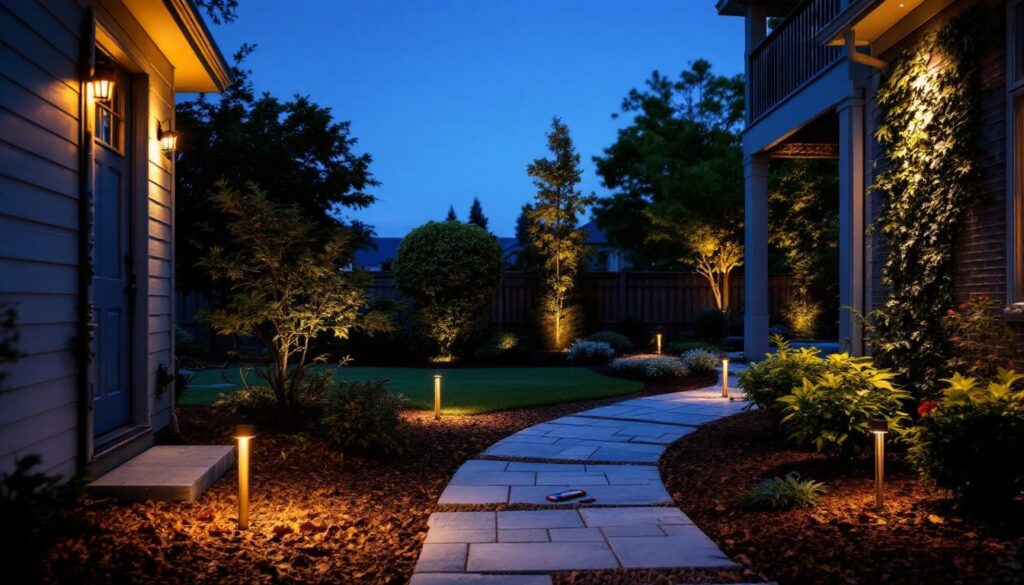
Draw a simple overhead sketch of your yard and mark fixture locations. Space path lights about 10 feet apart along walkways, closer if the path is narrow or turns sharply. Accent lights (spotlights and uplights) sit 4–6 feet from the plants or structures you want to highlight, aimed upward or at an angle. Avoid pointing lights directly at living areas or bedroom windows: the goal is to accent the landscape, not blind neighbors or yourself.
Calculate total wattage by adding up the wattage of every fixture. If you plan 18 fixtures at 7 watts each, you need a minimum 126-watt transformer, go one size up to 150 or 300 watts for headroom. Then figure cable distance: measure from the transformer location to the farthest fixture (add a few feet for slack). This determines your wire gauge.
Consider voltage drop: as electricity travels down thin wire over long distances, voltage decreases. Landscape Lighting: Transform Your pathways and gardens with properly sized cable, undersized wire will make distant fixtures dimmer. As a rule, keep runs under 150 feet with 12 AWG cable: use 10 AWG for anything longer. Many pros sketch the transformer and cable path overlaid on a printed site plan, this avoids burying cable under future hardscape and reminds you where to dig carefully later.
Step-by-Step Installation Guide
Positioning Fixtures and Running Cable
Start by laying out all fixtures on the ground at their intended locations. Plug in the transformer (without connecting the cable yet) and set it to test mode if available. This verifies power before you dig.
Now route your cable. Walk the path from the transformer to the farthest fixture, staying away from existing garden beds you don’t want to disturb. Mark the route with chalk or spray paint. Dig a shallow trench, 6 inches deep is standard and protects the cable from mower blades without requiring conduit in most jurisdictions (confirm with local code).
Unroll the cable and lay it in the trench. At each fixture location, mark the cable with a small stake or flag. Don’t cut the cable yet: you’ll trim it once all positions are confirmed. Backfill the trench partially, then do a dry run: position each fixture, point it in the right direction, and confirm sight lines and spacing look correct. Adjust as needed, this is your only easy chance to move things.
Once satisfied, bury the cable fully. Keep at least 6 inches of soil over it. Outdoor Lighting Ideas: Transform your space by marking future cable paths on a simple site map so you don’t accidentally dig through them in years to come. Store the map indoors.
Connecting and Testing Your System
At the transformer, strip 2 inches of insulation from the main cable. Loosen the terminal screws on the transformer and insert the bare wire, tightening firmly. Most transformers have two terminals, polarity doesn’t matter for low voltage AC, but double-check your manual.
For each fixture, cut the cable and strip both ends. Use waterproof connectors (compression or push-on, depending on your kit). Slide the connector onto the exposed wire, crimp or push firmly, and verify the connection is tight by gently tugging. Moisture is the enemy: choose connectors rated for direct burial and consider silicone-sealed connectors for added protection in wet climates.
Once all fixtures are wired in parallel (not series, parallel means each fixture connects directly to the main cable), plug the transformer into a GFCI outlet. Turn it on. All lights should illuminate. If one is dim or off, check that connection first. Use a multimeter to measure voltage at the farthest fixture: it should read 10–11 volts minimum (12 volts at the transformer is normal: some drop over distance is expected).
If voltage at the end is below 10 volts, your wire is too thin or the run is too long. You’ll need to upsize the cable or split the circuit with a second transformer. Outdoor Track Lighting: Brightening decorative spaces sometimes demands similar attention to voltage, it’s a detail that separates amateur installs from professional-looking ones.
Finally, bury the cable fully, backfill the trench, and tamp it down. Mark the transformer location on a piece of tape and stick it to the outlet box for reference. Take a photo of the layout, too. Test the system once more at dusk to confirm everything works as designed. Adjust fixture angles if needed, you may need to reposition a spotlight after seeing it in actual darkness.