Table of Contents
ToggleFort Worth’s warm climate and sprawling suburban landscapes create perfect conditions for outdoor living, but when the sun sets, the magic ends fast without proper lighting. Whether you’re extending entertainment hours on the patio or creating safer pathways around your property, outdoor lighting transforms how you use your yard year-round. The right fixtures don’t just boost curb appeal: they add security, functionality, and that inviting glow that makes neighbors stop and admire. This guide walks you through practical outdoor lighting solutions tailored to Fort Worth homes, from low-voltage pathway lights to energy-efficient landscape fixtures you can install yourself.
Key Takeaways
- Outdoor lighting in Fort Worth is essential infrastructure that extends your entertaining season, boosts home security, and increases property resale value by meeting buyer expectations for well-lit outdoor spaces.
- Low-voltage pathway and accent lighting are DIY-friendly options that require minimal skill and no permits, making them the best starting point for homeowners new to outdoor lighting projects.
- LED fixtures are the energy-efficient choice, consuming 75% less power than incandescent bulbs and lasting 25,000–50,000 hours, with warm color temperatures (2700K–3000K) ideal for patios and cool whites (4000K+) better for security lighting.
- Fort Worth’s hot, humid climate demands weather-resistant fixtures with IP65+ ratings and rust-resistant materials like stainless steel and powder-coated aluminum to withstand freeze-thaw cycles and UV exposure.
- Motion-sensor flood lights mounted 10–12 feet high provide cost-effective security deterrence while saving energy by activating only during detection, with proper positioning preventing shadows on approach routes.
- Compare outdoor lighting fixtures by lumens rather than wattage to ensure true brightness, and budget $15–40 per pathway light, $30–80 for deck fixtures, and $50–150 for quality flood lights depending on features and materials.
Why Outdoor Lighting Matters in Fort Worth’s Climate and Lifestyle
Fort Worth sits in USDA hardiness zone 8a, with hot summers, mild winters, and occasional freeze-thaw cycles that demand weather-resistant fixtures. Beyond climate, the city’s culture of outdoor entertaining, backyard barbecues, deck hangouts, and landscape showcases, makes outdoor lighting essential infrastructure, not a luxury add-on.
Proper lighting extends your usable yard season and increases home safety. Pathway lights reduce trip hazards, while accent lighting highlights landscape features and deters unwanted visitors. Studies show homes with well-lit exteriors report fewer break-ins and appear more maintained. Plus, when you’re installing outdoor lighting ideas around Fort Worth, you’re investing in both functionality and resale value. Buyers expect outdoor spaces to be thoughtfully lit and accessible after dark.
Types of Outdoor Lighting for Fort Worth Homes and Landscapes
Pathway and Accent Lighting
Pathway lights are the foundation of outdoor lighting schemes. These low-voltage fixtures (typically 12V) cast pools of light on walkways, driveways, and garden beds without consuming much power or requiring a permit in most cases.
Standard pathway lights stand 12–24 inches tall, with integrated solar panels or plug-in transformers. Solar options work well in Fort Worth’s sunny climate but may dim during extended cloud cover. Plug-in versions maintain consistent brightness but require a GFCI outlet (ground-fault circuit interrupter) within 6 feet of the fixture, per NEC code.
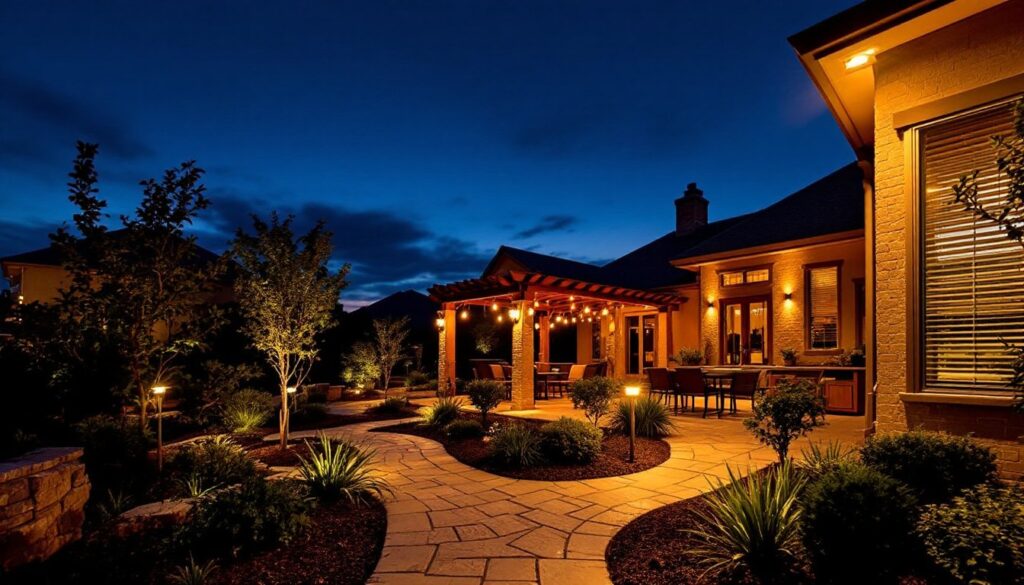
Accent lighting highlights architectural details, specimen plants, or water features. Use uplighting (casting light upward onto a tree or structure) or downlighting (casting shadows from above) to add depth and drama. Spike lights and well lights give precise control: recessed fixtures integrate seamlessly into hardscapes.
Patio and Deck Lighting Solutions
Patios and decks need brighter, more flexible lighting than pathways. Aim for 20–30 lumens per square foot for comfortable outdoor dining and conversation: higher light levels feel harsh and unnatural.
String lights (bistro or café-style) create ambient warmth and work well over pergolas or along fence lines. Recessed deck lights embed flush into fascia or decking to avoid trip hazards. Pendant fixtures hung from pergolas or posts provide focused downlighting. For larger entertainment areas, consider LED under-deck lights, which mount beneath deck boards and illuminate the ground below while staying hidden.
All patio lighting near water or moisture requires proper rating: look for IP65 or higher (ingress protection rating indicating dust and water resistance). Hard-wired deck lights need proper junction boxes and should be installed by someone comfortable running electrical cable in conduit.
Security and Landscape Lighting
Security lighting deters intruders and illuminates blind spots around entry doors, garage approaches, and fence lines. Motion-sensor flood lights are workhorses here, they use 50–100W (or 10–15W LED equivalent) and activate only when movement is detected, saving energy while catching attention.
Mount flood lights 10–12 feet high on fascia, garage eaves, or post-mounted arms. Position them to avoid casting shadows on approach routes. Dual-sensor models (PIR motion + daylight sensing) prevent daytime false triggers. Battery-operated solar flood lights exist but lack the reliability of hard-wired versions in Fort Worth’s variable light: reserve them for temporary coverage or areas without outlet access.
Landscape lighting sculpts your yard’s nighttime personality. Rock gardens, specimen shrubs, and water features glow under strategically placed spot and flood lights. Use warm color temperatures (2700K–3000K Kelvin) for living areas: cooler temps (4000K+) work better for security lighting. According to smart home technology reviews, modern outdoor lighting systems increasingly integrate with smart home hubs, letting you adjust brightness and schedule lighting from your phone. This works especially well for entertaining scenarios where you might want to shift lighting moods throughout the evening.
DIY Outdoor Lighting Installation Tips for Fort Worth Homeowners
Low-voltage pathway and accent lighting is one of the most DIY-friendly outdoor projects. Here’s the process:
Materials you’ll need:
- Low-voltage outdoor lighting kit (transformer, cable, fixtures, often sold as bundles)
- Shovel or spade
- Wire connectors (usually included)
- GFCI outdoor outlet (if using plug-in transformer)
Installation steps:
- Lay out your pathway or accent locations on a sketch: mark with spray paint or flags.
- Run low-voltage cable along the ground or in shallow trenches (buried cable protects against tripping and accidental cuts). Keep cable away from garden beds you’ll dig in seasonally.
- Connect fixtures to cable using provided connectors, they click together without soldering or stripping.
- Plug the transformer into a dedicated GFCI outlet outside: set timers or daylight-sensing switches as desired.
- Test all lights and adjust angles and positioning once installed.
For hard-wired deck or patio lights, stop here and hire a licensed electrician. Running 120V power in outdoor environments demands proper conduit, grounding, and permits. It’s not a shortcut area for DIYers.
Flood light and security light installation is moderate DIY work if you’re comfortable on a ladder and have basic electrical knowledge. Attach mounting arms to fascia or posts using lag bolts, run power through weatherproof conduit, and wire fixtures to a dedicated 15A circuit with a motion-sensor switch. If that last step sounds fuzzy, call an electrician.
Always wear safety glasses when cutting or drilling. Use gloves and long sleeves when handling spiky plants or rough landscape edges. Ear protection isn’t critical but helps when using power tools in outdoor settings.
Choosing Energy-Efficient and Weather-Resistant Lighting Options
LED outdoor fixtures have become the default for good reason: they consume 75% less energy than incandescent equivalents and last 25,000–50,000 hours versus 1,000 hours for incandescent bulbs.
For Fort Worth’s climate, prioritize IP65 or IP67 ratings (fully sealed against dust and water) and materials that resist rust and UV fading. Stainless steel, powder-coated aluminum, and marine-grade plastics hold up best. Avoid bare copper or untreated steel: they corrode quickly in humid summers.
Color temperature affects mood and perceived safety. Warm white (2700K) suits patios and pathways: cool white (4000K–5000K) works better for security. Dimmable LED fixtures let you adjust on the fly, though not all outdoor LEDs support dimming, check the spec sheet.
Smart outdoor lighting systems from companies reviewed on home automation sites let you automate schedules, adjust brightness remotely, and integrate with voice assistants. They cost more upfront but save time and energy over years of operation. For a small Fort Worth yard, a simple battery-operated solar pathway kit or a plug-in timer-controlled flood light covers most needs without the tech overhead.
When evaluating products, compare lumens (brightness) rather than wattage. A 10W LED flood light outshines a 50W incandescent: lumen output tells the real story. Expect to pay $15–40 per pathway light, $30–80 for deck fixtures, and $50–150 for quality flood lights depending on materials and smart features. Budget for a transformer or GFCI outlet if you don’t have one nearby: that’s another $40–100.