Table of Contents
ToggleMost homeowners overlook pantry lighting until they’re squinting at labels or fumbling in shadows during meal prep. Good pantry lighting does more than help you find the pasta, it makes your space feel organized, prevents food spoilage by letting you see what you actually have, and turns a utilitarian closet into a polished part of your kitchen. Whether you’re working with a walk-in pantry or a compact cabinet, the right lighting setup is one of the quickest wins in any home improvement project. We’ll walk you through seven practical lighting ideas that range from simple DIY upgrades to smart-home integrations, all designed to fit real budgets and skill levels.
Key Takeaways
- Pantry lighting ideas improve visibility for finding items, reduce food spoilage from duplicate purchases, and make storage feel organized rather than cluttered.
- Recessed LED fixtures provide even all-around coverage (plan for one fixture per 4–6 square feet) and range from $80–150 per fixture, making them the gold standard solution.
- LED strip lights are the quickest DIY upgrade for shelves, costing $30–80 per shelf, with high-CRI 95+ rated strips ensuring accurate color visibility for labels and contents.
- Motion-activated lights eliminate the frustration of hands-full situations and save energy, though they require manual overrides in pantries with temperature fluctuations.
- Smart lighting controls let you schedule lights and adjust color temperature via app, but start with a single smart bulb before investing in a full system to avoid costly novelty purchases.
Why Pantry Lighting Matters More Than You Think
Poor pantry lighting creates real problems. You reach for what you think is the right item and grab the wrong one. Duplicate purchases happen because you can’t see what’s already on the shelf. Perishables expire in the back while you use newer stock from the front, classic first-in, first-out failures that cost money.
Beyond function, lighting affects the overall feel of your home. A well-lit pantry looks intentional and organized, which carries through to how you perceive your entire kitchen. Dim, shadowy storage feels cluttered even when it’s perfectly neat. Good lighting also reduces eye strain when you’re checking labels or looking for specific items, which matters more than you’d think during your morning routine or evening meal prep. Modern pantry lighting solutions, from LED strips to recessed fixtures, use far less energy than older incandescent setups, so you’re looking at lower utility bills as a bonus.
Overhead Recessed Lighting for Maximum Coverage
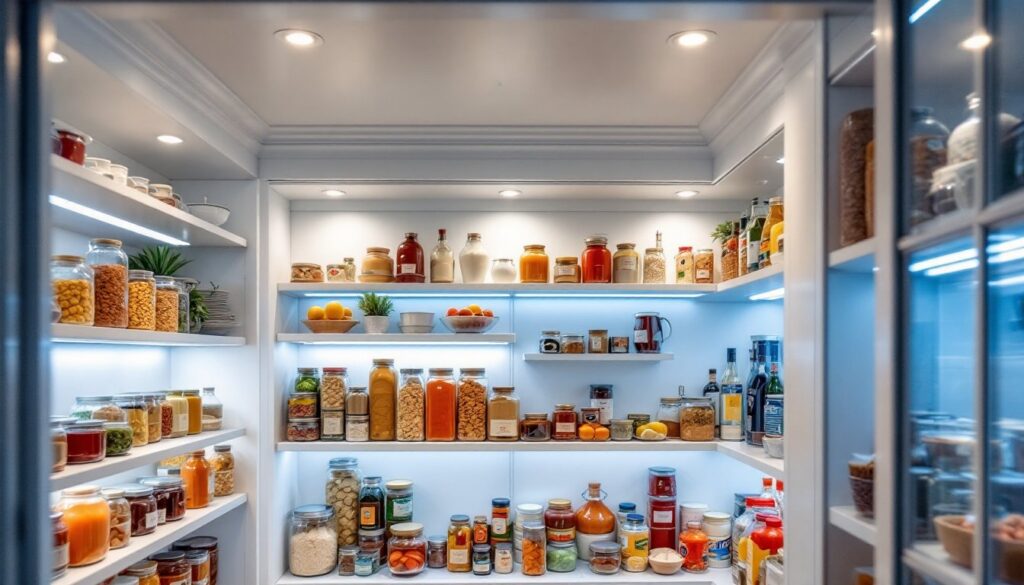
Recessed lighting (sometimes called can lights or pot lights) remains the gold standard for pantries because it provides even, all-around illumination without taking up visual space. Recessed Lighting: Transform your pantry with fixtures installed flush into the ceiling, which keeps sightlines clean and lets shelving dominate the visual space.
What to Install: Plan for one fixture per 4–6 square feet of floor area. For a typical 5×8 pantry, that’s usually two to three fixtures. Choose 4-inch or 6-inch trim rings with LED retrofit kits rated between 3000K and 4000K color temperature, this range mimics daylight without the harsh blue tint of cooler bulbs.
Installation Reality: This is a ceiling project, which means working from a ladder or scaffolding around existing drywall and electrical. If joists are exposed (unfinished basement or crawlspace above), installation is straightforward. If there’s finished drywall, you’ll need to cut holes and run wiring, definitely a time commitment, though not impossible for a confident DIYer with basic electrical knowledge. Many local codes require a licensed electrician for ceiling-mounted fixtures, so check with your building department first. Cost runs $80–150 per fixture plus installation labor.
LED Strip Lighting for Shelves and Drawers
LED strip lights are the easiest way to add task lighting to individual shelves, and they require almost no electrical work. These flexible ribbons of small bulbs stick to the underside of each shelf, creating pools of light on the shelf below, perfect for reading labels and seeing contents without shadows.
Key Specs: Buy high-CRI (color rendering index) strips rated 95+ so colors look accurate. Look for 5000K to 6500K color temperature for task areas: this cooler range improves visibility. Strips come in 16–32 feet per roll, and you can cut them to length with scissors or a utility knife. Most stick-on versions use 3M adhesive backing, though self-adhesive strips perform better on clean, dry surfaces than on dusty or glossy ones (clean with rubbing alcohol first).
Installation: Peel backing and press firmly into place. Most require a 12V power supply plugged into a nearby outlet or connected to a hardwired transformer. Some wireless options run on rechargeable batteries and clip underneath shelves, eliminating any wiring concerns entirely.
Pro Tip: Pair shelving strips with above sink lighting ideas if your pantry is adjacent to your kitchen work zone, unified lighting design makes the whole kitchen feel more intentional. Cost: $30–80 per shelf, depending on length and wireless capability.
Motion-Activated Lights for Convenience and Energy Savings
Motion sensors turn lights on automatically when someone enters the pantry and off after a set time, saving electricity and ending the “hands full, can’t flip the switch” frustration.
Options: Retrofit existing overhead fixtures with motion-sensing ballasts (for fluorescent or LED fixture wiring), or install standalone battery-powered motion-sensor LED lights that adhere to the ceiling or shelving. Battery models are the easiest path for renters or those avoiding electrical work.
Settings to Know: Adjustable sensitivity dials let you tune the motion detection so the pantry light doesn’t activate every time someone walks past the door. Timeout settings range from 30 seconds to several minutes, longer is usually better for pantry use so lights don’t cut out mid-inventory. Look for ambient light sensors that prevent the lights from turning on if the room is already bright enough.
Real-World Drawback: Motion sensors sometimes fail in pantries because pantries often don’t have good air circulation, and temperature swings can affect sensor calibration. If you install hardwired motion sensors, buy units with manual overrides so you can keep lights on if you’re doing a deep clean or reorganization. Installation for a retrofit starts at $50–100 per fixture.
Under-Cabinet Lighting to Highlight Your Best Items
Under-Cabinet Lighting: Transform your pantry shelves by mounting lights on the undersides of upper shelves, illuminating the shelves below with bright, shadow-free task lighting. This approach works especially well in open shelving designs or glass-front cabinet pantries where you want items to look intentional and well-displayed.
Fixture Types: LED puck lights (small circular fixtures) space 12–18 inches apart along a shelf edge provide discrete, focused beams. Linear LED bars run the full length of a shelf and deliver more consistent coverage. Both come in hardwired and battery-powered versions.
Color Temperature: For display-focused lighting (you want items to look appealing), use 2700K to 3000K to create warmth without the yellowish cast of older halogens. For task areas where you need to read expiration dates or compare products, step up to 4000K.
Installation: Hardwired fixtures require running low-voltage wiring behind or under shelves to a transformer plugged into a standard outlet. Battery-powered versions stick directly to shelf undersides with adhesive or mounting brackets. Resources like Homedit showcase gallery-style pantries that use under-cabinet lighting to turn storage into display, which inspires the whole approach. Cost: $40–150 depending on coverage area and wiring.
Smart Lighting Controls for Modern Pantries
Smart bulbs and smart switches let you control pantry lights from your phone, set schedules, or sync lighting to other rooms. An app-controlled setup means you can dim lights for morning calm or brighten them during evening meal prep without leaving your counter.
Smart Bulb Options: WiFi-connected LED bulbs screw into standard sockets and pair with smartphone apps. Most work with voice assistants like Alexa or Google Home, so you can say “turn on the pantry light” from anywhere. Color-tunable smart bulbs let you shift from warm evening light (2700K) to bright task light (5000K) depending on the time or task, useful if your pantry doubles as a snack station or assignments corner.
Smart Switches: If you prefer not to replace every bulb, install a smart switch that controls all overhead lights at once. These mount in your existing wall switch box and communicate via WiFi or Zigbee mesh networks. Many support scheduling, so lights turn on automatically at dusk or when motion is detected.
Gotchas: Smart systems add upfront cost ($15–50 per bulb, $30–100 per switch), and they require a stable WiFi connection. Budget-conscious DIYers sometimes find the novelty wears off, leaving expensive smart bulbs dark while they flip a basic switch out of habit. Start small, one smart bulb or a single fixture, before investing in a whole-system approach. Pair smart controls with Lighting Secrets articles for design inspiration.
Conclusion
Pantry lighting doesn’t have to mean a complete renovation. Start with what fits your timeline and skill level: LED strip lights or battery motion sensors for quick wins, recessed fixtures or under-cabinet options if you’re planning a larger update. The payoff, better visibility, energy savings, and a space that feels intentional rather than purely utilitarian, makes any pantry lighting upgrade worth the effort. Next time you open that pantry door, you’ll actually see what you have.